Difference between revisions of "Worldly Flora"
(→Moseke's Grace) |
|||
| Line 232: | Line 232: | ||
<br>'''Abilities:''Sap is a two part toxin, one part increases the tactile feel of things. The other is a painful stinging, these two in conjunction make for a quite unpleasant experience. | <br>'''Abilities:''Sap is a two part toxin, one part increases the tactile feel of things. The other is a painful stinging, these two in conjunction make for a quite unpleasant experience. | ||
An alchemist or Poisoner would be able to separate the different properties of the sap assuming they had the knowledge that it was not a singular, but two different properties at work, the inflammation and stinging coming from the bark, the sap the source of the tactile enhancement. | An alchemist or Poisoner would be able to separate the different properties of the sap assuming they had the knowledge that it was not a singular, but two different properties at work, the inflammation and stinging coming from the bark, the sap the source of the tactile enhancement. | ||
| + | ==Young's Bite== | ||
| + | '''Quick Facts:''' | ||
| + | Edible plant with leaves that can be used as an inhibitor. | ||
| + | |||
| + | Height: 2-4” | ||
| + | |||
| + | Width: 1” | ||
| + | |||
| + | Length: 1” | ||
| + | |||
| + | Native to: Northern Idalos | ||
| + | |||
| + | '''Locations:''' Grasslands throughout the world. | ||
| + | |||
| + | '''Appearance:''' Young’s Bite was discovered and classified in conjunction with Dogwalker by two colleagues. Somewhat ironically, the two each claimed to have found them both, and their relationship imitated that of the plants they had discovered. Each claimed one, naming it to spite the other. Young’s Bite is rumoured to have been a jab at a rather pronounced overbite. | ||
| + | |||
| + | This plant has a tall stem covered in tiny bristles. Tiny flowers bloom around the tip, usually a shade of purple or pink. Small, round leaves jut out in rings around the stem, a flat green colour. The stem is thick, nearly an inch in diameter, and can be peeled for the edible interior. It tastes rather bland, but can easily harvested in large numbers and contains a mouthful of fresh, portable water. | ||
| + | |||
| + | '''Habitat:''' It typically will grow in grasslands, clumped in areas of significant moisture. It is extremely common along riverbanks or lakes where it can get full sun. Like many plants, it has been grown for arcs in greenhouses around the world, mainly for their use as a flower. The use of their petals is not a well-known fact. | ||
| + | |||
| + | This plant has had an unending conflict with another plant, the Dogwalker. The Dogwalker originated on the East continent, near Athart, but due to travel, both have invaded the other’s territory. The Dogwalker relies heavily on moisture to grow, as does Young’s Bite, but the Dogwalker is a far more demanding plant. As such, Young's Bite was at a disadvantage as the roots of the Dogwalker secrete a fluid that kills this plant's own. As such, both flora are found in identical environments, but you will never find the two together. | ||
| + | |||
| + | '''Lifespan and Development:''' This plant relies on bees and other insects to carry its pollen, crossbreeding with nearby plants to make pinhead-sized seeds which float on the winds quite easily. It grows incredibly fast, from germination to fully grown within 30 trials. Once it has released its seeds, however, the plant withers and dies, losing both its edibility and the effect of the plant’s leaves. | ||
| + | |||
| + | '''Uses:''' The plant itself is a rather pretty flower, and has been grown around the world for usage in bouquets. The leaves have a more sinister ability when inhaled. | ||
| + | |||
| + | They must be either burnt over a fire or inhaled as a powder in order to be used as an inhibitor, and no one has been able to successfully combine ingredients to bypass this unfortunate drawback. Any poison or drug, once inhaled along with vaporized Young's Bite, will remain dormant in the bloodstream for up to a season. | ||
| + | |||
| + | During that time, if the subject is exposed to the fluid excreted from the roots of the Dogwalker, a chemical reaction takes place, and the chemical inhibited by the Young’s Bite activates. This allows poisonings and drug dosages to be activated long after being initially administered, or to stall the effects of a medicine, if needed. | ||
| + | |||
| + | Also, by burning Dogwalker's powdered body with the leaves of Young's Bite, a thick smoke is created that acts much like a laughing gas. | ||
| + | |||
| + | '''Abilities:''' Useful Reagent for poison and Medicine. | ||
| + | |||
| + | '''Credit:''' Vluharqih | ||
Revision as of 06:23, 20 March 2018
Contents
Dogwalker
Credit: Vluharqih
Quick Facts: Large, bush-like plant that bears fruit.
Height: 2-4 ft.
Width: 3 ft.
Fruit: Large, apple-like fruits tasting more like grapes
Native to: Wilds around Athart.
Locations: Grasslands across the world.
Appearance: Dogwalker was discovered and classified in conjunction with Young’s Bite by two colleagues. Somewhat ironically, the two each claimed to have found them both, and their relationship imitated that of the plants they had discovered. Each claimed one, naming it to spite the other. Dogwalker is rumoured to be a jab at the other researcher’s family business- dog breeding- but many think there may be another meaning.
This plant is large and shoots out branches in every direction from its central root. The bark is a pale green colour, yet still woody in texture. It flowers are of medium size that cover its branches, making the plant seem like a large bouquet. When the plant blooms the sight simply takes your breath away. Vibrant colours cover the branches, one colour fading seamlessly into the next.
Habitat: It typically will grow in grasslands, clumped in areas of significant moisture. It is extremely common along riverbanks or lakes where it can get full sun. This plant requires plenty of light, and will quickly fade if some of its branches do not receive enough. Dogwalker has been grown in greenhouses as a common houseplant. When blooming, the tree is stunning, but it requires significant work to trim and water correctly.
This plant has had an unending conflict with another plant, Young's Bite. The Dogwalker originated on the East continent, near Athart, but due to travel, both have invaded the other’s territory. The Dogwalker relies heavily on moisture to grow, as does Young’s Bite, but the Dogwalker is a far more demanding plant. As such, it was at a disadvantage, however the roots of the Dogwalker secrete a fluid that kills off the roots of Young’s Bite. The two plants can be found in identical environments, but you will never find them together.
Lifespan and Development: The plant is self germinating, bearing many similarities to a mushroom. Most of the plant is actually underground, with a deep and rich network supplying the plant with its required nutrition. The plant flowers overnight, the petals curling up during the day, and will bloom for the Hot Cycle. The flowers are then slowly turned into the plant’s fruit over the course of Vhalar, and it is left barren for the remainder of the arc.
The plant can last a long time if cared for properly and rarely dies from age. Often it falls to burrowing insects such as termites that eat away at its roots, or competition growing nearby and blocking out its sun. By ingesting the root, the burrowing insects mutate the trigger, absorbing it throughout their body. By burning their powdered bodies with the leaves of Young's Bite, a thick smoke is created that acts much like a laughing gas.
Uses: This secretions of the roots of this plant are used as the trigger for the inhibitor created from the leaves of Young’s Bite. The apple-like fruits are eaten as an oddity, few willing to spend the time and energy necessary to successfully grow these plants.
Flash Poplar

Quick Facts: The flash poplar is the plant with the most ruins to its name. Due to its limited lifespan, the flash poplar is one of the least studied plants on Idalos.
Height: 20-40 m (30 m on average)
Width: up to 2 m
Lifespan: 5 trials
Fruit: None
Poison: None
Native to: All of Idalos, except the hottest and coldest places
Locations: All of Idalos, except the hottest and coldest places
Created By: Sintih
Appearance: A white to greenish, grey colored bark is visible all arc around. It's covered in darker cuts or breaks that spread out over the bark the older the tree gets. Flash poplar seem to spread these quicker than normal poplar. The leaves are spirally arranged and vary in shape from rounded triangular to circular, with a long petiole (leaf stem). In Saun and Vhalar, the leaves change color to a brown-orange or bright gold before falling. While indistinguishable from normal poplar trees at first glance they can be identified by their lack of fruit bearing abilities. As the flash poplar doesn't reproduce in any way currently understood by the races of Idalos, they don't seem to have a need for bearing fruit and spreading seeds and so do not grow the red, bean like flowers that poplar use to hold seeds in.

Habitat: This is where the Flash poplar becomes famous. There is little to nothing known about them apart from the fact that they appear and disappear within trials. They've been spotted almost everywhere except Oscillus, the hotlands and the frozen wastes in the northern region. The flash poplar seems content with existing wherever it pops up and then leaves after five trials. The flash poplar seems to have no basis for where to appear and has been spotted inside of buildings or towns, resulting in the absolute ruination of those places five trials later.
Lifespan and Development: The leading flash poplar lives for five trials while the following ones live for three or four trials. There doesn't seem to be a system of reproduction for the flash poplar as they appear at random. A single flash poplar will appear in any location and occupy the space. There is no growth from seed to adult tree, one trial there is nothing, the next a fully grown poplar is standing there. One trial later, the single poplar has turned into a forest 750 meters in diameters. The trial after, it's one and a half kilometers in diameter. For the trial after that, nothing changes in the forest and it lacks the usual sounds of a normal forests as animals don't have the time to move into the newly found forest. On the fifth trial, the flash poplar forest crumbles within a break, the trees falling as if they don't have roots to uphold them and decaying at a rapid pace. By the end of the fifth trial, there is only a highly fertile track of land left with no sight of the flash poplar ever having been there.
Uses: The flash poplar's appearance is random and can happen inside of buildings or in the middle of settlements. These appearances always end up in the overgrowing of said buildings or settlements and the ruination of them. The fact that they leave behind a highly fertile soil is only a meager compensation for the loss of a settlement, and sometimes, lives. To this day there have been no reports of flash poplar appearing in major cities but nobody is quite sure what they would need to do if that were to be the case someday.
Temperament: N/A
Abilities: Rapid reproduction (Apparently): From a single tree to a forest 750 meters in diameter overnight is an unseen speed of growth and reproduction in Idalos. This speed is also one of the reasons why nobody has ever managed to properly study the tree as the time between birth and death is so short that researchers and botanists often don't have the enough time to get to the site before it has vanished again. (Due to the lack of scientific study, this is a guess from the scientific communities Idalos over.)
Teleportation (Apparently): As the first flash poplar appears from nowhere and then brings in others to grow around it, people have attributed this ability to the flash poplar. The first tree always appears out of nowhere (as if in a flash) and heralds the arrival of the forest but a trial later and the expansion of the forest the trial after that. (Due to the lack of scientific study, this is a guess from the scientific communities Idalos over.)
Frostcap Enoki

Created By: Symbri
- Location: Deciduous forests worldwide
- Native To: Northern Idalos
- Height: 2-4 inches
- Width: 3-5 inches
- Length: 3-5 inches
- Purpose: Medicinal mushroom for those who know it.
- Price: N/A
Habitat: Often found around the bases of trees in the deeper sections of forests where the sunlight is choked out by the leaves of trees.
Lifespan and Development: These mushrooms take around three weeks to a month to come full circle depending on the ambient temperatures of the season; the warmer the season the faster they grow and produce. Spores are expelled by the stalk that has stored heat and uses the stored energy to spray the spores. What makes the Frostcap neat is perhaps it's unique nature. One would assume that a plant that frosts over would in fact like colder frigid climates, which is in fact not the case for this unique species. the method by which it reproduces in fact hardly works in the winter seasons. The Frostcap spreads its spores by expelling them from around it's stalk on updrafts created by stored energy. Thus the reason that the frost cap is cold is that the cap is actually stealing energy from the air in an endothermic reaction and storing said energy in its stalk to germinate.
Uses: Improvised ice packs, and in small doses a natural fever aid. the stalks can also be used to induce retching.
Temperament: Plant
Abilities: the cap contains Diaphoretics, which induce sweating and can help regulate fevers. However in large doses this could cause excessive sweating and possibly dehydration making the cap a poor choice for a meal.
Iffliol

Created By: Vluharqih
- Location: Coastal regions of non extreme climates
- Native To: Central Idalos
- Height: 8"-16"
- Width: 4-5"
- Length: 4-5"
- Purpose: Stimulant and Blood clotting agent
- Price: N/A
Habitat: They are seen in large batches all across coasts, and the smell of them has become synonymous with the sea for many. They grow better in more temperate climates, with an excess of rain and a moderate temperature arc round. They have spread throughout the world, however are much more common in areas that satisfy the above. They have developed a special relationship with numerous species of turtles, as the eggs are laid in their root balls. The root system protects the eggs as they grow and as the plants die, the eggs then hatch, and their scurry towards the ocean kicks up enough dirt to cover the seeds dropped by the flower.
Lifespan and Development: The flower grows as one of a batch, up to a dozen flowers sprouting from a single seed. Each flower then drops another seed, causing very dense patches, with very little between. They are rarely spread by animals. They die from low temperatures, so often they die off during Cylus, however if it is warm, they can survive for several arcs.
Uses: The plant is often grown for the seeds, as in small doses they can be used to stop bleeding. Additionally, the small petals can be dried and used as a stimulant, causing increased heart rate and sensitivity.
Temperament: Plant
Abilities: The seeds can be used to stop bleeding, when boiled into a paste, however care has to be taken that very little of the paste leaks into the bloodstream, lest the healer become the killer. When used as a poison, it is often ground and added to strong-tasting wines and ales, as the flavour is quite distinct. It can take arcs of constant dosing for the poison to take effect, and as such is not often used for this purpose. The petals can be dried and used as a stimulant, and are a common additive to other medications to speed up the intake rates.
Moseke's Grace

Quick Facts: Height: 5-15 meters tall
Width: 5-10 meters diameter
Fruit: None
Poison: None
Native to: Global, except Viden and Oscillus
Locations: Global, except Viden and Oscillus
Appearance: Averaging at 7-12m tall and 6-8m wide, this tree bears white, almost opalescent bark and silver, spade shaped leaves. The trunk bloats out into a shape reminiscent of a bottle, and its branches form a rather small but dense canopy, generally no more than 2-3m wider than the widest point of the trunk.
Habitat: Global
Lifespan and Development: Moseke's Grace has only ever been seen at a stage of full growth and development. It is widely believed that it is placed by Moseke where she see's fit, fully grown and healthy. Age can be discerned from the colour of the bark, the younger the tree, the closer the colour of the bark to the leaves, which whitens and lightens as it ages, the oldest trees having pure white bark. It does require a minimal supply of water to maintain it, as well as full sun for the majority of the day. The tree can last for long periods without water, as it uses the water stored in the trunk to support itself. It's root system is expansive and far reaching, allowing the tree to make the most of even the smallest amounts of water. Due to its need for water and sunlight, Mosekes Grace thrives in most areas, though very rarely in arid and desert conditions, and not at all in the ice logged continents. Despite it's semi-mythical beginnings, once Mokeke's Grace has its roots firmly in the ground it is as any other tree, though a little hardier and helpful than most.
Uses: The trunk stores clear, fresh water, which can be tapped and ingested safely. The bark can be stripped in thin layers to be dried and eaten like jerky. The spade shaped leaves are nutritious, and can be used to make soups and teas, though it is fairly bitter and unpleasant to eat. Larger layers of bark can be harvested to be used as a shelter from the elements, however more substantial building is not possible, at it cannot withstand great weights. The root of the tree, which grow close to the grounds surface, can be harvested easily with little damage to the tree, and then baked, similar to a potato. Due to the water logged nature of the tree, it is not possible to start fires with the wood, however once dried the wood can be formed into flexible and light canoes. The wood is rarely used to craft tools, but is sought after for crafting jewellery and decorative pieces, due to the stunning appearance.
Abilities: When not needed for survival by an individual this tree is elusive and rare, to the point that many believe it to be little more than a myth. However, when needed by an individual, the tree seems to present itself, its colouring giving the impression that the tree is glowing. Many believe that the tree is the creation of Moseke, and that the immortal send's the tree to aid those lost in the wilderness, close to death.
Credit: Kala
Reaver Vines
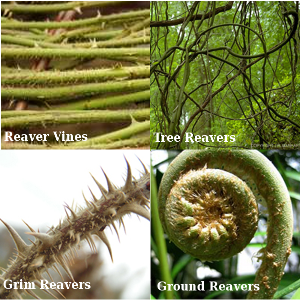
Credit: Patrick
Quick Facts: Agile, Toxic, Easily Agitated
Native to: Wetlands, Rain forests, and Oasis's
Locations: Central Idalos (Frequent) Western Idalos (Occasionally) Eastern Idalos (Rare)
Appearance: Reaver Vines have several different variations depending on their location, each with their own level of potential danger. Usually green in appearance to match vegetation, these vines can easily appear like normal vines save for the fact they are littered with deadly thorns. These plants rely on their victims blood to enrich the soil, and often ensnare scavengers who come searching for the body of the dead.
Tree Reavers are the forest variation of Reaver Vines. These vines grow within densely populated forests, more commonly found in rain forests and jungles. Though they're inclined to dominate treetops for smaller prey, their immense rate of growth allows them to tangle and in turn trap larger prey on the forest floor. Typically, they look more like regular vines as their thorn patterns are much smaller and less consistent than other Reaver Vines. When traversing through their native environment, one must keep a weather eye on the formation of the vines as well as any signs of activity.
Tree Reavers will snake and ensnare prey in their network.
Ground Reavers are more common in marshes, wetlands, and even humid and moist areas of plains. They appear more like stalks than actual vines, until they release from their coiled state to reveal their presence on unwary victims that trek too close. These Reaver Vines are littered with miniature thorns that break off once pricked into the skin, proving to be just as deadly as its cousin, the Grim Reaver. While they're not as difficult to notice in an open area, they are still lethal to encounter, should one attempt to harvest them. Unlike Grim Reavers, Ground Reavers only react defensively towards predators and other mammals that seek to ingest the bulb, as Ground Reavers produce a wickedly sweep sap uncommon in the wilderness. The plant does not seek to spread out, and remains a tightly coiled knot until something draws near. It then lashes out, striking at the trespasser before coiling itself back up. Ground Reavers will coil like tentacles until their prey comes close.
Grim Reavers are the most lethal and distinguishable of the Reaver Vines, as they are adorned with numerous barbed thorns that are deadly to even touch. Grim Reavers typically appear red while their thorns flourish to match their environment, ranging from rich green to even a dull white coloration during their growth. These are the type of vines that rarely found, rumored to appear in isolated locations. The Grim Reavers have developed an incredibly potent version of the poison found in their cousins. Unlike the other variants, this poison has been modified to allow for absorption through the skin, in addition to an increased toxicity when introduced to the bloodstream.
Grim Reavers are the deadliest variation of Reaver Vines.
Lifespan and Development: Reaver Vines started as bulbs that evolved during their growth among tree trunks as predator and prey alike sought these out for their incredibly sweet sap and nutrient-rich roots. It wasn't until accidental cross pollination happened that these bulbs evolved, and their roots grew rapidly into vines that eventually developed toxins to protect the bulb. Eventually the plant itself adapted and took on a predatory nature, using its defensive capabilities as a hostile reaction to any living being that drew near its grasp.
Eventually the plant earned the name Reaver Vines as a derived term from "the Reaper's Reavers" or "Death Vines", slowly mistranslated into various languages. Their nature and temperament have proven them to be deadly when encountered in the wilds, and that name eventually became accepted. They act as predators but only within their own territory; the range in which the vines have grown. While they will move and flail about like a living organism, Reaver Vines strongly rely on camouflage and entrapment to capture their prey, often using the smell of the sap to lure their victims to their untimely demise. When a vine has a creature within its proximity it wastes no chance in wrapping them within their grasp, coiling around its prey much like a snake until the flesh is torn apart by its thorns.
The bulbs of the Ground and Grim Reavers rely on a secondary pair of roots that act as a sensory network, indicating when a possible meal on the ground is drawing close. A Reaver Vine can either be killed by locating its source, the bulb, elsewhere within the vicinity; usually the greater the concentration of vines the closer to the bulb. The rarer of the Reaver Vines however require a much riskier approach, as their bulbs are hidden between the base stalks and the roots within ground. With the location of the bulb discovered one need only to use fire or a sharp tool to crack the bulb, rendering the rest of the vines useless the moment its core has been exposed to light. The other method for handling Reaver Vines, while not as effective, has less risk compared to the first but still contains high danger. As one can merely hack or burn away the vines that are in their way, at the chance of ruining a decent harvest of materials from these creatures.
The bulbs of the Tree Reavers do not have a root system, and as such rely on vibrations sent through their vines. This sense is not as strong, however they have balanced this out by casting a wide net of vines across the treetops.
Uses: Reaver Vines produce a poison that numbs the nerves on introduction to the blood, causing temporary paralysis to the victim injected with the venom. The bulbs of the Vines produce a highly aromatic sap that is sweeter than honey, and said to make miracle and beauty salves when harvested. The roots of the vines prove to have invaluable healing properties, though prove difficult to harvest as they diminish quickly due to lack of moisture.
Temperament: Highly aggressive and territorial when it comes to both prey and predators, the Reaver Vines tend to act defensively rather than offensively. Their aggression however elevates when nourishment is required, therefore they will ensnare any living organism within range. They are considered highly dangerous and best avoided unless one seeks to harvest their ingredients, placing that person in a position where they approach at their own risk.
Abilities: Aromatic sap is used to lure prey both small and large, while vines act as tentacles to capture prey, and their roots act as sensory indicators to detect where their prey is when it closes in. Depending on the region they grow within, thorns will act as barbs to prick and paralyze trapped prey with poison; Grim Reaver vines have thorns so sharp they could slice a carcass into multiple parts.
Safewater Sentinel

Created By: Brother
- Location: Near freshwater sources in non extreme climates
- Native To: Central Idalos
- Height: 6 inches to a foot
- Width: 2 to 3 inches
- Purpose: Indicator of drinkable water
- Price: N/A
Habitat: Near sources of fresh clean water, mountain rivers and springs are common spots.
Lifespan and Development: Short lived mushrooms, they can sprout up over night and are usually full grown by a week.A peculiarity of this mushroom is that they like to grow around springs and mountain streams and other sources of fresh water.
Uses: Particularly good to eat, and a decent source of nutrients, furthermore they are a telltale marker of the source of water they are near being safe for consumption. They taste pretty good, some would describe it as a Nutty, fishy flavor. Quite healthy there isn't much else to say, good in stews, or on a skewer.
These mushrooms can also be cut up and dehydrated. when a dehydrated chunk of a safewater sentinel is dropped into water it will only swell up and rehydrate in clean water.
Temperament: Plant
Abilities: A rather bland reagent, but a creative alchemist might find that they have an almost purifying effect on solutions they are in, negating small amounts of toxins, or that they would be good for making potions or other such mixtures good for fortifying the body.
Vibatir

Credit: Noth
Quick Facts: Absorb sound, Underground, Undulating
Height: 2 foot
Width: 8 inches
Length: 4 inches
Fruit: Detachable roots
Poison: Foul tasting leaves
Native to: Underground/Caves
Locations: Northern, Central, and Eastern Idalos.
Appearance: The Vibatir appears to be a long tube which opens upwards into a wide bowl. This bowl is marked with various walls that divide it over, and these divisions are random for each plant, though it is common among them to find the most divisions near the outer pieces of the bowl, and the least within the center. The very center of the bowl contains a small hole which appears to be covered only by a thin membrane. This membrane will pulse and shake at even the slightest amount of noise in it's general area, and the intensity with which it does so can lead to the entire Vibatir plant seeming to shimmer and undulate. Several leaves wrap themselves around the central tube, but they stop growing past the bowl.
Habitat: The Vibatir plant is found almost exclusively underground, or in dark, and dry areas. Despite that, it has managed to spread throughout some of the caverns of Northern, Central, and Eastern Idalos. It is not uncommon for the plant to grow from the roof, or from odd crevices within the rocky masses, but it is extremely rare to see a Vibatir plant surviving whilst in the sunlight, especially during Saun. Plants will not commonly cluster together, but will typically be within viewing distance of one another.
Lifespan and Development: The Vibatir plant grows from a detached root. This root will implant itself slowly into the ground, or in some cases, the ceiling, and will then bury itself. This process typically takes between forty-fifty Trials. Once buried, the plant will begin to grow back towards the surface with a tube which gradually grows in size as the plant matures. The initial root will be consumed for nutrients, and smaller roots will be put into place until a nutrient capturing system can be established.
After another twenty Trials past piercing the surface with the tube, the plant will begin to form the bowl on top of it. The bowl; like the tube, will continue to grow as the plant matures. The bowl will capture any sound vibrations that bounce around nearby it, and entrap them within it's maze of walls. Eventually, those vibrating sounds will be absorbed into the sensitive membrane which will convert the kinetic energy into more readily usable energy. This causes an area around the plant of around ten feet squared wherein sound cannot penetrate beyond a slight whisper which only lasts for an extremely brief interval. Now that food can be captured by the plant, it begins to grow steadily in size until it matures after around two Arcs. Once mature, the plant will form a new root, and will push it as far away from itself as possible. This process typically takes another Arc to complete. Once the plant has removed the root from it's presence as far as it possibly can, it separates it completely from itself, and allows the process to begin anew.
Fertilization occurs after the root has been released, and therefore requires the presence of small insects, or other creatures to gather pollen, and then investigate the root. The root releases a sweet scent for around three Trials after it is released, after which point the scent will cease, and the foul taste inherent in the plant will take place. During the time period whilst the root smells sweetly, it can be consumed without worry of digestive problems.
Animals will typically take hold of the sweet smelling roots, and will carry them throughout the cave to other areas, allowing for the plant to further propagate itself as opposed to simply clustering in a single area. Outside birds and other animals will also occasionally be drawn into a cave to retrieve these roots, and therefore are the cause for the plant's spread to other subterranean systems.
Uses: Soundproofing a room. Roots can be used as bait, or as a light poison without worry of killing, or seriously wounding target.
Temperament: N/A
Abilities: While a root, the plant releases a sweet smell. After a Trial, that smell disappears, and the plant becomes poisonous to digest, and foul tasting. This poison is non-lethal, and simply causes digestive issues for a short while. The plant will absorb sound within a ten foot squared space around itself, and make speech virtually impossible.
Whipping Willow

Created By: Brother
- Location: Temperate forests worldly
- Native To: Western Idalos
- Height:10 meters average (35 feet or so)
- Width: 7 meters or so. (23 feet some branches can reach quite far)
- Purpose: A semi common willow tree with a some rather nefarious abilities.
- Price: N/A
Habitat: Near streams and water sources. Anywhere with a consistent source of water.
Lifespan and Development:Mature at about three years. Never really fully grown.
Uses: Makes good switches for naughty people. The wood makes for good bows or anything needing flexible wood.
Temperament: Plant
'Abilities:Sap is a two part toxin, one part increases the tactile feel of things. The other is a painful stinging, these two in conjunction make for a quite unpleasant experience.
An alchemist or Poisoner would be able to separate the different properties of the sap assuming they had the knowledge that it was not a singular, but two different properties at work, the inflammation and stinging coming from the bark, the sap the source of the tactile enhancement.
Young's Bite
Quick Facts: Edible plant with leaves that can be used as an inhibitor.
Height: 2-4”
Width: 1”
Length: 1”
Native to: Northern Idalos
Locations: Grasslands throughout the world.
Appearance: Young’s Bite was discovered and classified in conjunction with Dogwalker by two colleagues. Somewhat ironically, the two each claimed to have found them both, and their relationship imitated that of the plants they had discovered. Each claimed one, naming it to spite the other. Young’s Bite is rumoured to have been a jab at a rather pronounced overbite.
This plant has a tall stem covered in tiny bristles. Tiny flowers bloom around the tip, usually a shade of purple or pink. Small, round leaves jut out in rings around the stem, a flat green colour. The stem is thick, nearly an inch in diameter, and can be peeled for the edible interior. It tastes rather bland, but can easily harvested in large numbers and contains a mouthful of fresh, portable water.
Habitat: It typically will grow in grasslands, clumped in areas of significant moisture. It is extremely common along riverbanks or lakes where it can get full sun. Like many plants, it has been grown for arcs in greenhouses around the world, mainly for their use as a flower. The use of their petals is not a well-known fact.
This plant has had an unending conflict with another plant, the Dogwalker. The Dogwalker originated on the East continent, near Athart, but due to travel, both have invaded the other’s territory. The Dogwalker relies heavily on moisture to grow, as does Young’s Bite, but the Dogwalker is a far more demanding plant. As such, Young's Bite was at a disadvantage as the roots of the Dogwalker secrete a fluid that kills this plant's own. As such, both flora are found in identical environments, but you will never find the two together.
Lifespan and Development: This plant relies on bees and other insects to carry its pollen, crossbreeding with nearby plants to make pinhead-sized seeds which float on the winds quite easily. It grows incredibly fast, from germination to fully grown within 30 trials. Once it has released its seeds, however, the plant withers and dies, losing both its edibility and the effect of the plant’s leaves.
Uses: The plant itself is a rather pretty flower, and has been grown around the world for usage in bouquets. The leaves have a more sinister ability when inhaled.
They must be either burnt over a fire or inhaled as a powder in order to be used as an inhibitor, and no one has been able to successfully combine ingredients to bypass this unfortunate drawback. Any poison or drug, once inhaled along with vaporized Young's Bite, will remain dormant in the bloodstream for up to a season.
During that time, if the subject is exposed to the fluid excreted from the roots of the Dogwalker, a chemical reaction takes place, and the chemical inhibited by the Young’s Bite activates. This allows poisonings and drug dosages to be activated long after being initially administered, or to stall the effects of a medicine, if needed.
Also, by burning Dogwalker's powdered body with the leaves of Young's Bite, a thick smoke is created that acts much like a laughing gas.
Abilities: Useful Reagent for poison and Medicine.
Credit: Vluharqih