Category:The Kidnapper Spider
Contents
Overview
Name: The Kidnapper
Fauna Type: Insect
Mod Status: Self
Height: 1 - 1 1/2 Feet
Length: 1 1/2 Feet (Body) 2 Feet (Arms)
Weight: 15 - 25 lbs
Native to:
Locations:
Created By:
Appearance:
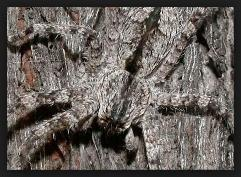
This creature is not of a size that would generally be considered monstrous for most types of creatures. But for a spider, a body the size of a large cat and legs the length of an average human’s arms, is monstrous indeed. But it is not only the size that makes this arachnid formidable. It also possesses a variable pigmentation ability that makes it very difficult to spot.
Habitat:
Found primarily in thick forest areas, the Kidnapper sits over both human and game trails, looking for all the world like a part of the trees its victims pass beneath and between. It does not cast webs, though it does produce silk that is stronger than the strongest rope and is highly sought after. It only ever excretes this silk in a single strand to drop silently on its prey, which is mostly small forest game but has been known to include small children and babies, from which it gets its name.
Lifespan and Development:
During one such effort, it was noted early on that there were no eggs in evidence. The nature of the creature’s means of reproducing became grimly plain after a documented battle with the colony’s defenders. They are not particularly difficult to kill, a single arrow or well placed sword stroke to the abdomen doing the trick. But during the battle, several legs were hacked off from less accurate swings of the blades, and being a creature of mysterious abilities, many of these legs were gathered up to take back and research their camouflage ability. It took only a few days for full new creatures to grow from the severed legs, and the returning party was reduced drastically in number and arrived empty-handed, horribly traumatized, weeping and babbling tales almost beyond belief.
But as if to prove that humans are also more capable of insidious evil than nature, researchers are working on how to put the severed legs of the creatures in temporary stasis, in hopes of finding a way to weaponize the little beasts’ reproduction method as a form of infiltrating an enemy stronghold with an infestation.
Diet:
Its prey, which is mostly small forest game, but has been known to include small children and babies, from which it gets its name.
They are surprisingly social and have been known to coordinate efforts to bring large creatures into the trees to feed when small game is sparse. The lack of any obvious webbing makes it difficult to tell when a colony is dangerously close. Nor do they use wide "nets" of webbing to bring large victims into the trees. In addition to venom and web strands, the creatures can release an enzyme the neutralizes the adhesive.
Temperament:
Abilities:
Rather than biting, it stings with a fast-acting paralytic venom to still the cries and struggles of its victim. These stingers are located at the tips of the creatures foremost pair of legs, so it only needs to brush an exposed area with a leg to render the target helpless. Larger creatures may need two or more stings to be completely paralyzed. Once this is accomplished, it pulls its victims into the trees to feast upon its blood and tissue. Unlike most spiders, it does not inject its tissue-dissolving enzyme while its victim still lives. Instead it gives an additional sting of its paralytic venom into its victim’s heart or lungs, bringing death quickly. Then, its feast begins.
Because the creature counts on this deep sting to bring the death that stills its meal permanently, the initial paralytic venom never evolved the necessity to be that long-lasting. So grown men have been known to be rescued and begin to recover movement after as little as 15 bits, with full recovery after a break or two. It is also true that an excessive number of "surface" stings will eventually bring the venom flowing into the heart or lungs anyway, so armor is no guarantee of safety.
So the creatures use an instinctive understanding of block and tackle arrays to set up a pulley system, laying down patches of this enzyme on branches, and using twined "ropes" of webbing across these patches for surprising leverage. In this way, 4 or 5 of these spiders can pull a grown man's armored body into the trees. For this reason, lone hunters have to be very careful in the deep woods; and their disappearances have been the reason that some Kidnapper colonies have been found.
Uses:
Also found to be of unexpected benefit are the stingers in the front legs. When purged of any residual paralytic toxin, they serve as remarkably effective injection mediums for medics. Up until quite recently, the introduction of any beneficial compound into the bloodstream was done in the same fashion as most poisons; a cut on the arm, a smear of chemicals, and a pressed bandage and/or poultice to speed healing. Use of this "needle" has been a breakthrough for medics everywhere.
See Also
This category currently contains no pages or media.