Difference between revisions of "Southern Fauna"
(→Uwär Bysez) |
(→Iyọ) |
||
| Line 105: | Line 105: | ||
::Lightsource – Various colors | ::Lightsource – Various colors | ||
::In a time of need, they have been used as a food source | ::In a time of need, they have been used as a food source | ||
| + | |||
| + | =Spulmokawarta= | ||
| + | [[File:Spunkypup.png|left|link=]]'''Created By:''' Toscun'ahesesi | ||
| + | ::'''Locations:''' Makubwa Lori, Area surrounding Rhakros | ||
| + | ::'''Height:''' up to 40 in at shoulder | ||
| + | ::'''Width:''' up to ~30 inches | ||
| + | ::'''Length:''' 35 to 71 in | ||
| + | ::'''Weight:''' 50 - 350 kg (Weight is Common to Rare) | ||
| + | ::'''Native To:''' West-Central and Southern Idalos | ||
| + | |||
| + | ''' Appearance:''' The Spulmokawarta is a solid bulky mass of muscle, looking decidedly top heavy with a broad chest and head. Though looking rather like a hairless canine, there are some immediately obvious and rather nightmarish departures from this design. Probably the first noticed are the vestigial legs that dangle uselessly from its body, occasionally scrabbling ineffectually at nothing. The exact number and placement of these varies by creature, but it would be extremely rare for a Spulmokawarta to have none or two have more than four fully functional limbs. Their functional limbs end in broad, sharp claws, often caked in whatever the Spulmokawarta brought down last. When not being used offensively, they are also well suited to digging, and if no suitable cave or burrow is found, the Spulmokawarta will dig its own. | ||
| + | <br><Br> | ||
| + | Then you move on to the tough callused, almost armour like skin patches and the bone spurs that cover much of their back, neck and the front of their legs. The bone spurs making taking a bite out of them a fairly painful prospect for competing predators and the thicker skin helps to deflect weaponry or at least cause it to cut a little less deeply. | ||
| + | <br><br> | ||
| + | The tail reminds the more squeamish of a cockroach, and though it lacks any particular function, it does perhaps reflect their tenacity and the difficulty of exterminating them once a pack settles into an area. | ||
| + | <br><br> | ||
| + | The head would be fairly inoffensive, with small eyes and ears and a wide snout if not for the horror show going on in it's mouth. As well as having a bone crushingly strong bite and a mouthful of jagged teeth, the Spulmokawarta also has two lower mandibles on either side. While normally kept flat along it's jaw, when hunting or fighting, if a Spulmokawarta is going to miss landing a solid bite, it will often extend whichever mandible is closest and toss its head in such a way that it rends its opponents regardless. As well as a standard tongue, it has a tentacle-like appendage on either side of its mouth that can extend roughly a foot and is used to grasp and hold onto or pull in prey for a killing bite. | ||
| + | <br><br> | ||
| + | '''Habitat:''' Spulmokawarta will live anywhere there is enough prey to support them, though their hairless nature means they cannot tolerate extreme cold. Although their connection to Lisarra has never been proven, it is certainly true they only seem to pop up where she has been active... | ||
| + | <br><br> | ||
| + | '''Lifespan and Development:''' Although the Spulmokawarta can live to around 15 arcs, this is unusual as they live violent, brutal lives and rarely die of old age. The grow quickly, reaching physical and sexual maturity in about an arc. That said, they continue to grow throughout their lives, so it is perhaps lucky that most die fairly young. Their gestation period tends to be around six months with litters of 3 to 5 living puppies and several stillborn most common. It is not unusual for the pups to kill each other or be devoured at this stage. | ||
| + | <br><br> | ||
| + | Should they make it through their first few weeks however, they are provided for by their mother. Once they've reached maturity the males will stay with their mother forming a pack while the females are cast out. A female must then go and find another matriarch to challenge for control of the pack and breeding rights. This helps prevent inbreeding, though it has been known to happen. To be fair, genetics are already not on their side so while certainly not good for the species, it doesn't really make things any worse than they already are. | ||
| + | <br><Br> | ||
| + | Lone Spulmokawarta encountered then tend to be younger females who have not yet bred. Packs are either a mother and her puppies or a female and her mates. As one might expect with this system, it is the females who tend to be larger and dominant, though sheer attrition and harder life means the males are more numerous. | ||
| + | <br><br> | ||
| + | '''Diet:''' Spulmokawarta are strictly carnivorous predators. They will eat anything they are capable of killing. Not only that, but they are one of very few predators who will kill for the sake of killing even when they have no intention of feeding. It is this even more than their monstrous appearance that sets them at odds with the Sev'ryn who firmly believe in taking only what you need and preserving balance. | ||
| + | <br><br> | ||
| + | '''Temperament:''' Vicious and unpredictable. Common Sev'ryn opinion is that the Spulmokawarta which is literally a bastardization of monster-dog, was a creature created by Lisarras plague, and as such it is a twisted perversion of what it is meant to be and consequently on the brink of madness as a creature that should not exist. | ||
| + | <br><br> | ||
| + | On occasion, should a Spulmokawarta come upon a person who is out of reach, it might try such canine tricks as wagging it's tail or wiggling about with its belly in the air. Sometimes going as far as to limp and whine as if injured. It will behave as if it is perfectly domesticated and friendly. Right up until the person is within reach, when it will revert to the vicious predator it is. | ||
| + | <br><br> | ||
| + | '''Abilities:''' Spulmokawarta have a keen sense of smell and though not the fastest have a high endurance making them accurate and persistent trackers. When they do tangle with something that fights back, the rough skin and bone spurs along its back help deflect weapons, teeth and claws, though it is not impervious, merely tough. Its underbelly is noticeably free of these defences. The two extra tongue like appendages on either side of its mouth are in fact more similar to tentacles and are used to grasp prey and make it easier to either bite down or to gash with the extra mandibles. | ||
| + | It's spit carries all manner of germs, and any bite or wound inflicted by either its mouth or mandibles is almost guaranteed to get infected unless promptly treated by a knowledgeable healer. | ||
| + | <br><br> | ||
| + | Beyond that, other than the fact that it is a fairly canny predator, the Spulmokawarta has no particular abilities. | ||
| + | <br><br> | ||
| + | '''Uses:''' None. The meat is widely agreed to be inedible. It is marginally better than starving but has a foul taste and is quite likely to induce vomiting. Although individual bone spurs could be used to craft something it's hide is largely deemed worthless and unworkable. | ||
=Uwär Bysez= | =Uwär Bysez= | ||
Revision as of 21:24, 12 October 2017
These creatures can be found in the Western region and specifically in the cities of Augiery, Desnind, Niomyr, and Quacia. Unless specified, these animals and monsters can be self moderated.
Arnabari
Created By: Toscun'ahesesi
- Location: Makubwa Lori
- Height: 100-130 cm 0r 40-51 inches at shoulder
- Width: ~45 cm or ~18 inches
- Length: ~115 cm or ~45 inches
- Weight: 330-418lbs or 150-190 kg
- Native to: Southern Idalos
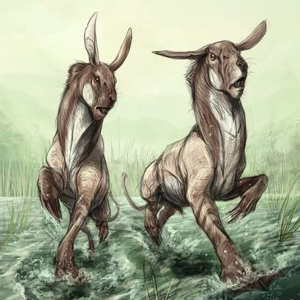
Appearance: Although specific colouring as well as coat length and thickness can vary slightly depending on the climate it lives in, Arnabari are always neutral brown or cream colours, with occasional white on their underbellies, they often have darker striping on their legs, as well as a dorsal stripe. They have thick, well muscled bodies with their shoulders being definitively higher than their rumps.
Their feet are tri-clawed with an opposing well developed carpal pad, making them look almost like a cross between typical mammalian pawed and avian feet. There is also a fairly tough webbing between their front three toes making them better paddlers, as well as spreading their weight more evenly on uncertain surfaces such as snow. Their tales are long and hairless, being used mainly for inter species communication of mood and intent.
Their heads rise from thick, powerful yet graceful necks are are fairly lapin-esque. With long, active ears rising from their heads, quick brown eyes and constantly moving noses, they give off an impression of alertness.
Habitat: Arnabari are fairly adaptive, but prefer forested areas. They have been seen on plains or in swamps as well. As long as there is enough vegetation to support them, and not too many predators, the Arnabari might move in and flourish.
Lifespan and Development: Arnabari live on average 20 Arcs, but have on rare occasions been known to live as many as 30. They take roughly 11 seasons to gestate and three is the most common number of offspring. They are mature both physically and sexually at around 2 Arcs. At this point, they will leave to find their own mates.
While not territorial, Arnabari will find and bond with a singular mate. Once this is done, they will consistently stay with this mate. Several bonded pairs might be in the same area at once if it can support them, but are largely uninterested in each other. The only exception to this is their offspring, who will be minded by both parents until they reach maturity. Should one of the pair die, the other will usually refuse to eat, wasting away until death although on rare occasions one may continue to live solitarily.
It is this habit that makes the creature looked upon so favorable by the Sev'ryn, who compare it to their own Dabi Uaya tradition.
Diet: Arnabari are wholly herbivorous. They can survive on a diet of grasses, but prefer young shoots, vegetables, fruits and the like. Many of their favourite plant foods are aquatic, which likely explains the webbing of their feet and their willingness to embrace swampland.
Temperament: Arnabari can be domesticated, and their pair bonding makes them ideal driving creatures. With their solid build, a pair of Arnabari can haul as much as a strong horse. That said, they tend to be extremely stubborn and not particularly affectionate to their 'owners'. They are also prized in some regions because they are more likely to fight to defend their mate than the average horse when faced with a predator.
Abilities: Arnabari have no notable abilities.
Uses:
- Draft animals
- Very rarely as mounts for children or smaller folks
- Food, the meat being gamey but more than palatable and even favoured by some
- Pelt, the fur and leather are nothing special but they are usable
Ditos

Created By: Nymph
- Location: Augiery
- Weight: 1500 pounds
- Height: 5 meters
- Length: 7 meters
- Purpose: Occasionally used as a food source
- Population: The Naerikk suspect there are only 25-30 of these creatures left within the cavern.
Habitat: The ditos live in the underground caverns beneath the Southern Region. They claim large areas of the cavern. Anywhere from 2-4 dito will live in the same territory at any given point. This group consists of the mated pair and their growing offspring. When the offspring are old enough, they will journey through the cavern to establish their own territory and create their own family. Within their territory there are often large "farms" of fungi that the dito ingest.
Lifespan and Development: Mothers tend to give birth to one or two eggs every 50-60 arcs. A female dito will give birth to 2-3 clutches before passing on. Once born, the dito will remain in the egg for a full arc. A young dito will emerge from the egg, hanging around its mother as it grows. It takes approximately 30-40 arcs before the creature will be fully grown. It relies on its parents to provide for most of its life. A grown dito will then leave the nuclear family to make room for the mother's next clutch. It will seek an area within the cavern to call its own. After establishing its territory, the dito will seek out a mate. These beasts mate for life; the loss of their loved one often causes severe depression of the one left behind. It is not uncommon for a dito to pass on due to starvation after losing its mate because they choose not to survive. It is a peculiar trait the Naerikk have noted.
The ditos are blind despite having large black eyes. Having been in darkness for many arcs, the creatures have not found use for sight. Instead, they have long tendrils that waves back and forth in front of their face. These tendrils act like fingers, sensing objects in front of their face. It is suspected that the creature can sense nutritional substances and moisture through these finger-like projections.
Diet: Ditos eat fungus and small plants that cling to the roof of the cavern they preside in. They are mainly fungivores, it is not unheard of for them to suck a bat or two into their mouths during a meal.
Temperament: A dito is a very peaceful creature when not provoked. They simply exist, choosing to occupy with drinking, eating, and sleeping. When provoked, they tend to attempt flight. Fighting is difficult for them as they are large, slow, and do not have physical features to use as weapons. If push comes to shove, they will attempt to smack a creature with their tail to buy themselves time to get away.
Abilities: The fungus that the dito normally feed on are toxic to mortals and most other creatures within the cave. They have a special fermentation process within their hindgut that allows them to destroy the toxins and gain nutrients from the meat of the mushroom. Once enough fungus has been ingested, ditos will produce a pellet in their feces that is edible to mortals. These pellets are soft, spongy, and may be harvested. Known as "dito loaves", this form of food is often seen on Augierian naval ships during extended voyages due to the high calorie content.
Icraphern
Created By: Avrae Kyric
- Locations: Makubwa Lori, Magani (Captive)
- Pronunciation: Ick-Ra-Fern
- Height: 2 feet
- Length: 3-4 feet
- Weight: ~25 pounds/11.5 kg
- Native to: Southern Idalos
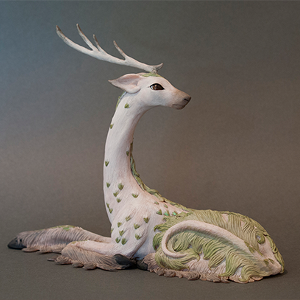
Appearance: Icrapherns greatly resemble the modern day deer, but they're also very different. They're very small, delicate creatures, only growing to about two feet tall at their torso (or three feet if you count their extremely long neck and antler), and being around three to four feel long in length. With four very slender, fragile legs, Icrapherns are often shaky when standing and prefer to be sat down. Therefore, they're not very active creatures except when they have to be, running almost like they're on stilts. Icrapherns have a single white antler in the middle of their head. Their head is fairly small and elegantly pointed, with usually beautiful, dark eyes that range in colors of brown and green. An Icraphern's neck is exceptionally long and tall. The Icraphern's ears are delicate and leaf-shaped, pointed backwards. However, the biggest diferential of an Icraphern from a deer is their pelt. Icrapherns have a base pelt of white, but their fur gets longer and changes color- the tips and long strands are a pale green color. The fur on their skinny legs is also very long and a grayish color. The Icraphern's tail is long, white, and short furred, often curling at the tip.
Temperament: There's no hazard to them. Icrapherns are peaceful creatures, who won't fight or become aggressive. They lean heavily towards fleeing when there's danger, and have no offensive attributes.
Other Information: The Icraphern are a herbivore species, they don't eat meat. They've been said to lay in soft, hidden spots and poke their head up with their long necks through the foliage to observe their surroundings. Icraphern meat is a delicacy, but they're more prized for their incredibly soft pelts. Their shaky, weak bodies make them easy prey, and if it weren't for the Icraphern's keen senses, ability to fit into small hiding spaces, and tendency to breed like that of rabbits, they might be a more rare species because of poaching.
Iyọ
Created By: Nymph
- Locations: Makubwa Lori, Desnind (Captive)
- Height: 1-1.5 feet
- Wingspan: 2-3 feet
- Length: 0.5-1 foot
- Weight: Caterpillar: 2-4 kg/4-8 lbs; Butterfly: 1-2 kg/2-4 lbs
- Native to: Southern Idalos
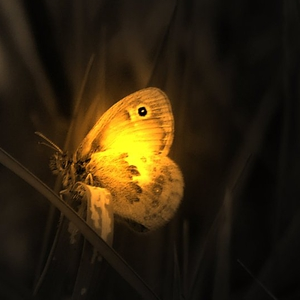
Appearance: The Iyọ are born as round, translucent, glowing eggs just before the new arc begins (Cylus). They are about the size of a nectarine at this stage, able to fit within the palm of any human hand. The color of the egg’s glow is highly suggestive of the adult Iyọ color. Once the eggs hatch, a fat and fuzzy caterpillar emerges with stripes of the glow color they will carry throughout their life. These “glow bugs” start off small, about the size of an average adult human’s palm. Over the course of the next year, they get progressively bigger until they weight about 4-8 pounds and have a length of approximately 1 foot. At this point, they are mostly fat. They have spent all of their life storing energy for the final transformation, which starts at the beginning of Cylus.

For some reason, all these “glow bugs” form a cocoon starting the 1st Trial of Cylus. The cocoon is thick enough to prevent any light from escaping and all wild caterpillars are very difficult to find at this time. They spend the next 21 to 22 trials within the cocoon. Once they have incubated, cocoon splits to reveal a large butterfly with their wings glowing the color they were born with. Captive butterflies are expected to mate with their lamp mate within a day or two before the release on the Trial 23 of Cylus.
Iyọ have been highly sought after mostly for their glowing nature. They come in three colors: yellow, green, and blue. The larger the caterpillar gets, the more light they emit. This has become extremely beneficial for people using them as lamps as they tend to produce the most light later in an arc.
Habitat: Wild Iyọ commonly live in the forests of the Southern Region. They are native to the Makubwa Lori mostly because they were a result of Lisirra’s plague. The contamination of the forest resulted in a mutation of normal butterflies. This mutation caused the caterpillar stripes and the wings of an adult butterfly to glow. This species was named after the word “lamp” in Xanthea, as Sev’ryn native to Desnind have used these mutated insects to provide light to their city.

Lifespan and Development: Iyọ live for one full arc, being born on the 23rd of Cylus and generally dying at the end of Cylus the following arc. They spend a majority of their life living as caterpillars, eating and growing fat for the final metamorphosis. The cocoon portion of their life lasts 21-22 days, based on gender. Males tend to emerge from the cocoon first and the females follow a day later. The mating process is uneventful, as they produce similar to fish. The eggs are laid by the female and then fertilized by the male.
For the next 24-36 hours, the eggs will move from opaque to translucent before finally glowing the color that they will maintain for the rest of their lives. If an egg remains opaque, it is generally removed as it is unfertilized. Captive Iyọ clutches will be manipulated so eggs of the same glow color are housed in the same glass lamp for the rest of the year. At the end of the year, the Sev'ryn hope that the pair include a male and a female. If there are two males or two females in a lamp, this pair will not produce a clutch. Since there is about 8-10 eggs in a clutch and about 50% are fertilized, there are enough Iyọ to fill lamps that did not have a mated pair.
The eggs hatch by the end of Cylus, around the time the adults die. The young caterpillars will glow from hatching and immediately start feasting on the forage the lamp owner provides. They will grow slowly over the next arc until the cycle starts over again.
Diet: The caterpillars have a voracious appetite for anything green, be it grass or leaves to tough vines or water plants. Anything that lives and grows is food for these small eating machines. They do not need a source of water as the plants they ingest are generally high in water content; however, this means that dried plant material is not a nutritious food source. The adults eat a similar diet of plants, but will also suck nectar from night flowers that bloom during Cylus.
Temperament: These animals are no known to have a temperament. They are known to glowing and eating. Beyond that, they have no real 'personality'.
Abilities:
- Glowing Stripes/Wings - Green, Yellow, or Blue
Uses:
- Lightsource – Various colors
- In a time of need, they have been used as a food source
Spulmokawarta
Created By: Toscun'ahesesi
- Locations: Makubwa Lori, Area surrounding Rhakros
- Height: up to 40 in at shoulder
- Width: up to ~30 inches
- Length: 35 to 71 in
- Weight: 50 - 350 kg (Weight is Common to Rare)
- Native To: West-Central and Southern Idalos
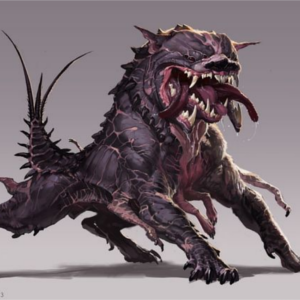
Appearance: The Spulmokawarta is a solid bulky mass of muscle, looking decidedly top heavy with a broad chest and head. Though looking rather like a hairless canine, there are some immediately obvious and rather nightmarish departures from this design. Probably the first noticed are the vestigial legs that dangle uselessly from its body, occasionally scrabbling ineffectually at nothing. The exact number and placement of these varies by creature, but it would be extremely rare for a Spulmokawarta to have none or two have more than four fully functional limbs. Their functional limbs end in broad, sharp claws, often caked in whatever the Spulmokawarta brought down last. When not being used offensively, they are also well suited to digging, and if no suitable cave or burrow is found, the Spulmokawarta will dig its own.
Then you move on to the tough callused, almost armour like skin patches and the bone spurs that cover much of their back, neck and the front of their legs. The bone spurs making taking a bite out of them a fairly painful prospect for competing predators and the thicker skin helps to deflect weaponry or at least cause it to cut a little less deeply.
The tail reminds the more squeamish of a cockroach, and though it lacks any particular function, it does perhaps reflect their tenacity and the difficulty of exterminating them once a pack settles into an area.
The head would be fairly inoffensive, with small eyes and ears and a wide snout if not for the horror show going on in it's mouth. As well as having a bone crushingly strong bite and a mouthful of jagged teeth, the Spulmokawarta also has two lower mandibles on either side. While normally kept flat along it's jaw, when hunting or fighting, if a Spulmokawarta is going to miss landing a solid bite, it will often extend whichever mandible is closest and toss its head in such a way that it rends its opponents regardless. As well as a standard tongue, it has a tentacle-like appendage on either side of its mouth that can extend roughly a foot and is used to grasp and hold onto or pull in prey for a killing bite.
Habitat: Spulmokawarta will live anywhere there is enough prey to support them, though their hairless nature means they cannot tolerate extreme cold. Although their connection to Lisarra has never been proven, it is certainly true they only seem to pop up where she has been active...
Lifespan and Development: Although the Spulmokawarta can live to around 15 arcs, this is unusual as they live violent, brutal lives and rarely die of old age. The grow quickly, reaching physical and sexual maturity in about an arc. That said, they continue to grow throughout their lives, so it is perhaps lucky that most die fairly young. Their gestation period tends to be around six months with litters of 3 to 5 living puppies and several stillborn most common. It is not unusual for the pups to kill each other or be devoured at this stage.
Should they make it through their first few weeks however, they are provided for by their mother. Once they've reached maturity the males will stay with their mother forming a pack while the females are cast out. A female must then go and find another matriarch to challenge for control of the pack and breeding rights. This helps prevent inbreeding, though it has been known to happen. To be fair, genetics are already not on their side so while certainly not good for the species, it doesn't really make things any worse than they already are.
Lone Spulmokawarta encountered then tend to be younger females who have not yet bred. Packs are either a mother and her puppies or a female and her mates. As one might expect with this system, it is the females who tend to be larger and dominant, though sheer attrition and harder life means the males are more numerous.
Diet: Spulmokawarta are strictly carnivorous predators. They will eat anything they are capable of killing. Not only that, but they are one of very few predators who will kill for the sake of killing even when they have no intention of feeding. It is this even more than their monstrous appearance that sets them at odds with the Sev'ryn who firmly believe in taking only what you need and preserving balance.
Temperament: Vicious and unpredictable. Common Sev'ryn opinion is that the Spulmokawarta which is literally a bastardization of monster-dog, was a creature created by Lisarras plague, and as such it is a twisted perversion of what it is meant to be and consequently on the brink of madness as a creature that should not exist.
On occasion, should a Spulmokawarta come upon a person who is out of reach, it might try such canine tricks as wagging it's tail or wiggling about with its belly in the air. Sometimes going as far as to limp and whine as if injured. It will behave as if it is perfectly domesticated and friendly. Right up until the person is within reach, when it will revert to the vicious predator it is.
Abilities: Spulmokawarta have a keen sense of smell and though not the fastest have a high endurance making them accurate and persistent trackers. When they do tangle with something that fights back, the rough skin and bone spurs along its back help deflect weapons, teeth and claws, though it is not impervious, merely tough. Its underbelly is noticeably free of these defences. The two extra tongue like appendages on either side of its mouth are in fact more similar to tentacles and are used to grasp prey and make it easier to either bite down or to gash with the extra mandibles.
It's spit carries all manner of germs, and any bite or wound inflicted by either its mouth or mandibles is almost guaranteed to get infected unless promptly treated by a knowledgeable healer.
Beyond that, other than the fact that it is a fairly canny predator, the Spulmokawarta has no particular abilities.
Uses: None. The meat is widely agreed to be inedible. It is marginally better than starving but has a foul taste and is quite likely to induce vomiting. Although individual bone spurs could be used to craft something it's hide is largely deemed worthless and unworkable.
Uwär Bysez

Created By: Ti'niva
- Location: Makubwa Lori
- Height to Head: 160-200 cm (Male); 120-140 cm (Female)
- Width (shoulder to shoulder): 90-160 cm (Male); 80-100 cm (Female)
- Length (nose to base of tail): 300-410 cm (male); 300-380 cm (Female)
- Weight: > 2 tonnes (Male); > 1.8 tonnes (Female)
Details: Their name in common is literally translated to "snake beast." These creatures are native to the Makubwa Lori and have a small population the creatures are solitary and very territorial. They tend to come in shades of green and brown as well as the rare blue. The creatures have thick skin which is incredibly difficult to pierce and, therefore, difficult to hunt and kill. Due to the rarity of their useful parts (teeth, skin, claws and poison) there are no set prices and costs are up to the individual retailer. These creatures are incredibly dangerous and many will keep as far away from them as possible. The only real reasons these creatures would be hunted would for city security or if somebody required the specific items and could afford to supply a hunting party.
Lifespan and Development: The Uwär Bysez can live up to approximately 140 arcs. The creature reaches maturity at 40 arcs. At around 20 arcs the creature will have also gained the ability to spit poison and by 30 arcs the creature's claws excrete poison.
Diet: The Uwär Bysez is omnivorous. It will eat plants when necessary but it prefers to eat meat. The creature will attack and hunt nearly all other creatures with few being bigger than it in the forest. They are highly territorial and may occasionally kill without the intent to eat if their den is threatened. Although they are of basic sentience, they are highly aware their skin is impenetrable to many weapons, which can make them extremely dangerous.
Temperament: The Uwär Bysez are aggressive and territorial. They each have an area in the forest that they consider theirs. Many of them will make sure not to invade another Uwär Bysez's territory as a battle between two of these creatures is often fatal for both participants.
Abilities:
- Poison bite: The bite of the Uwär Bysez is incredibly dangerous to anyone who experiences it. The poison that is produced is a neurotoxin which acts quickly to numb the entire area of the bite. It spreads quickly and if not treated the neurotoxin will eventually cause a shutdown the body. This complete shutdown can take a few trials as it varies based on size of the offending beast. If not treated, the victim is guaranteed to die.
- Poison spit: The creature can spit poison at its prey or attacker and cause blindness if it goes in the eyes. The effects of the poison act differently in comparison to injection into the bloodstream and will not result in complete nervous system failure.
- Poison claws: The effects of this are directly the same as that of the poison bite except there is an 8% chance that the poison will not make its way into the bloodstream.
Weaknesses: The Uwär Bysez are weaker in the cold seasons. They hibernate during the last 33 trials of Zi'da and throughout Cylus and early Ashan. During this time they can be easily ambushed. Heated weapons (meaning they are glowing from the heat) have a higher chance of piercing their thick skin.