Off the Coast Fauna
The rare creatures of the Idalosian oceans, Oscillus, and the Iulure Islands can be found in this compilation. Unless specified, these animals can be self moderated.
Brinefish

Credit: Rei
- Location: Idalos Oceans
Appearance: The Brinefish is a common deep sea fish with slick and rubbery skin thats colored in drab shades to blend in with rocks and seaweed. They have large mouths that open to reveal needle-like teeth that are sharp and used for shredding the smaller fish they prey upon. They boast sharp spiny barbs on the trunks of their body that they catch up in seaweed to help them blend in with the surroundings. They can grow in lengths from twelve feet to the goliath size of thirty feet. Legends say that the most ancient of the fish can grow to 1,000 lbs if they can avoid a fisherman, but the average weight of this giant fish is usually around 400-600 lbs.
Habitat: The habitat of The Brinefish is mostly deep sea, drifting only towards the surface if the hunt requires them to. They are a common fish and can be found all throughout the Idalos oceans but, as they were aptly named, they are generally found in higher concentrations around the areas traversed by the city of Blackbrine.
Lifespan and Development: The longest lived Brinefish was believed to be 37 arcs old, though the legends of seafarers say that the goliath fish could very possibly live from 50-100 arcs. Male fish become sexually mature at 5-6 arcs of age and female slightly later at 6-7 arcs. They are known to form spawning groups of 100 fish or more when it comes time to lay their clutches. When the fish hatch they are expected to fend for themselves.
Diet: Brinefish are opportunistic hunters and choose to prey on slow moving and bottom feeding species. Crab is one of their main choices to eat, though smaller fish are also on the menu as well. Their needle-like teeth are perfect to shred meat. They make a bloody mess when they eat. They are lazy hunters and you will not find them chasing fast swimming species.
Temperament: Brinefish might be aggressive in their opportunistic hunting, but they are not aggressive towards people or species of fish that are larger than them. That is not to say that they cannot be provoked to self-defense if a person or fish goes after them.
Abilities: The barbs on the fish's sides that catch and tangle up seaweed and conceal them from their prey is their prime ability. The other, being the needle-like teeth, large and perfect for shredding.
Marra Iluna

Created By: Djinn
- Location: Ocean around Augiery
- Weight: 600 pounds
- Length: 24 feet
- Purpose: N/A
Habitat: Found in the seawater around Augiery and Sarraski, the Marra Iluna prefers the deep water far below the surface. Only coming to the lit surfaces to feed, the Marra Iluna is easily spotted due to its massive size and the ability to sap all light from the area around it.
Lifespan and Development: Like most fish, the Marra Iluna is born in the water, and remains there. Born the size of a bass, they grow immensely in the first two seasons of their lives. After quickly reaching their average size (24 feet in length, 600 lbs), the Marra Iluna's growth slows considerably. They are born with razor sharp teeth, and as they grow, they go through six sets. Upon reaching sexual maturity, they gain the ability to absorb the light around them.
Diet: As most oceanic predators do, the Marra Iluna feeds on smaller fish and saltwater eels. Occasionally, should a sailor fall overboard, the Marra Iluna will emerge from the depths quickly, a shadow with an infinite maw.
Temperament: Exceedingly aggressive and territorial, the Marra Iluna has been known to attack any and all creatures that make it into their habitats. Anything that disturbs its calm waters will draw the shadowy shark, and it isn't unheard of for the largest of the species to attack and sink ships.
Abilities: Incredibly fast, the Marra Iluna is able to reach speeds of up to 50 MPH in the water, capable of doing serious damage with the velocity when it hits its prey and ships. Additionally, the Marra Iluna has the ability to absorb the light around it, surrounding itself in inky darkness. Plenty of sailors have noted the growing blackness of the water with dread before being attacked by a Marra Iluna.
Sheen Whale
Credit: Rei
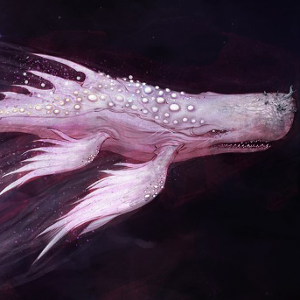
Appearance: The Sheen Whale is a species of whale that is extremely rare and its migratory habits largely unknown, making it a hard mammal to track down. Unlike the rubbery skin of most whales, the Sheen Whale possesses scales the color of mother of pearl that radiate a rainbow of colors when struck by light. On the top of a straight and rounded head is a blow hole for air. They have six thin and pointed dorsal fins on the top of their backs. They have long pectoral fins a third of the body length with ends that appear to be feathered. Their pelvic fins are smaller but also appear feathered on the ends. The tail is split in a wide v-shape like most whales, though the trunk of the tail is abnormally thick, giving it extra propulsion power. Here the ends of the tail fins are feathered in appearance. Inside the mouth are rows of small but sharp teeth, allowing the Sheen Whale to predate on smaller fish. The smallest recorded Sheen Whale was forty feet in length and the largest fifty feet in length. It is known range of sizes. The few Sheen Whales ever caught average around 80,000 lbs.
Habitat: Because the Sheen Whale is so rare and elusive, little is known about its habitat. From the few reported sightings, and even fewer catches, researchers are able to deduce that the Sheen Whales stay well away from coastal lines and much prefer the deep waters. It is believed that they do not often need air, for they are rarely seen cresting the surface to take in air. The Brineborn can confirm that the Sheen Whale is most commonly seen passing through their territory. It is known that during the Cold Cycle they seek warmer waters for mating and during the Hot Cycles they return to their hunting grounds.
Lifespan and Development: Much of what is known of the Sheen Whale is information about similar species. A Sheen Whale only produces offspring every three to four arcs, which possibly attributes to their rarity. It is believed that the haunting song of a Sheen Whale comes from the male species and is part of a mating ritual. Male whales will gather around a female and fight each other for her. A gestation period lasts a complete arc. When the young are born, the calves are nursed for up to arc before learning to catch and eat fish on their own. However, a Sheen Whale doesn't reach sexual maturity until six to ten arcs. The oldest recorded Sheen Whale was fifty arcs, though it is believed that a median age of death is probably closer to forty-five arcs.
Diet: Sheen Whales only feed during the Hot Cycle and survive off their fat stores during the Cold Cycle. Primarily, the Sheen Whale preys on small to large fish species, preferring those that congregate in schools as it makes it easier to catch more at one time. Though Sheen Whales are not generally pod animals, they will coordinate with one another to make a catch.
Temperament: Sheen Whales are often lone animals, keeping to themselves and their young. This is how most sightings of Sheen Whales have been noted. Though, a few sightings lead researchers to believe that they will form relationships with other Sheen Whales during feeding season to become better hunters. Sheen whales are not known for partnering with another whale life or any extended period of time. They are docile around humans and boats, though they will attack if they are first struck. Their only real threat is to the fish they need to survive.
Abilities: The Sheen Whale is an excellent hunter of fish and can outsmart even the trickiest schools of fish. It is also well-known that the Sheen Whale is extremely elusive and is almost never sighted.
Uses: Because of its beautiful mother-of-pearl scales, they are highly sought after for decorative pieces on clothes, jewelry, and armor. The scales themselves are not very durable and cannot be used to make armor on their own but can be used for a bit of flair. Because of their elusive nature, the meat of the Sheen Whale is also considered a delicacy. Sought out by master chefs, it has a subtle fishy flavor with succulent white meat. Nothing ever goes to waste on a Sheen Whale catch and the thick bones of the creature can have uses to jewelers, armorers and blacksmiths alike.