Western Fauna
These creatures can be found in the Western region and specifically in the cities of Ne'haer, Hiladrith, and Uthaldria. Unless specified, these animals and monsters can be self moderated.
Bruxen

Credit: Incubus
Found In: Ne'haer
Information: The Bruxen - often called Brux - are a race of cervidae (deer) that inhabit primarily the forestry surrounding Ne'haer and its suburban towns. Said to be a species enchanted by Qylios, who herself is known as the rider of the Alpha Brux of the Willow Woods, they are a highly intelligent species known to very frequently bond with biqaj, humans and other sapient races dwelling within Ne'haer. The Bruxen are a mount and battle companion, and they hold a special place in the hearts of those who worship and admire the Immortal who made them.
The Bruxen are a very large variant of the cervidae species, and as expected of Qylios' creations, they often exist as the leaders for communities of deer, elks and other members of their animal family. Your average adult male Bruxen is very large and muscular, standing at about one thousand and eighty pounds. The females are less sizable at eight hundred and fifty pounds on average, though respectively both male and female are significantly larger than even the most imposing elk. Males can get to a weight of over 1,700 pounds in extreme cases. Qylios is said to ride a male Brux who weighs over 2,000 pounds.
The animal's hide is known to be very sturdy, and the creatures are highly durable. It is due to their strength, discipline and durability that they are excellent mounts for wartime and travels - and they are considered to be apex predators in the wild if threatened by a carnivore or a human of destructive nature.
Price: If purchasing a domestic Bruxen in Ne'haer, their price is about 750 gn. There are some found for around this price in Argos and Uthaldria, though very uncommonly. Elsewhere, they are usually around 1250 gn, although you'd struggle to find a single one outside of Western Idalos.
Habitat: The Bruxen mostly dwell in the forests and valleys near to Ne'haer. A decent number live in Falcon Haven Forest, The Bend, and the grassy plains surrounding these areas, with some of the population living in the Willow Woods. There are estimated to be about twelve thousand total Bruxen in the wild, with about eight thousand in domestic households or as members of the military of Ne'haer.
As a result of the expansion of Ne'haer and its surrounding territories over time, the Bruxen's historic range of dwelling has been depleted by about fifty percent, and many worry that the creatures will fall to endangerment or even extinction in the wild with Ne'haer's continued growth. Furthermore, due to the megalomania and violence of the Cliffwalkers that dwell in the Willow Woods, the Brux have begun to become endangered in their original home and have depleted significantly in the wild. No matter how many Brux come to aid another in the felling of a Cliffwalker, they tend to be nearly unable to defeat them. Additionally they are slower than these beasts, and so their only option is usually to create a flash of light and attempt to hide.
Lifespan and Development: The Bruxen live to about thirty five years old, reaching full maturity at the age of three. They become self-sufficient at around a year and a half, on average, though many of them form bonds with deer and elk for their mutual survival even as early as eight months old.
The animals become venerable at the age of thirty, unable to properly function. Nearly all of these creatures face extreme hardship later in life, as their body begins to weaken and often becomes incapable of maintaining their weight. Bruxen are prone to illnesses such as eye cataracts, bowel issues and even forms of cancer, though it is said that if one is bonded to an individual close to Qylios that they tend to be significantly healthier and even stronger as a result.
Diet: Like elk, these creatures have four chambered stomachs. The Bruxen survive mostly on fruits and vegetation. They generally survive off of grass year-round, and in the colder seasons consume tree bark and roots. Their diet is very similar to elks as well as their anatomy. The Bruxen consume about 25% more food on a daily basis than an elk does, consuming about 25 lbs (12~ kg) of vegetation daily.
The favorite food of the Bruxen is - as popularly known in Ne'haer - blueberries. The creatures absolutely adore blueberries, with many of them capable of consuming over thirty pounds of it if given the option. They gain a great deal of protein and other nutrients from the food, and are said to be significantly healthier if they maintain a majority blueberry diet. There are many blueberry fields in Treth during particular cycles, and so the Bruxen are known to casually stroll into the town at night and pluck the fields dry. Originally this caused exceptional tension between the farmers of Treth and Ne'haer and the Bruxen, but government subsidies have been given to farms to support the health and development of the species.
Temperament: The Brux are highly docile in the far majority of situations. They are very trusting and tend to allow humans and other races to get near them, even to pet them. Many theorize that this is due to their connection to Qylios, while more scientific minds claim it is due to their durability and strength that they do not fear the sapient races of Idalos. Nevertheless, the creatures are very passive and as a result have been domesticated over the past few centuries.
While quick to trust individuals not to hurt them, the Bruxen are not quick to bond with others. They are often called the 'posh elks', as they tend to believe themselves to be highly worthy animals with an inherent superiority to that of their kin. In the mind of a Brux, no man or woman can tame them, but rather prove to them that they are a worthy comrade. Of course, inevitably, they are weak to blueberries and one who gifts them these fruits can gain immediate favor. However it is by valor and commitment that one truly gains a Bruxen as an ally, and many have imprinted on humans shortly after great feats such as the slaying of a Sylvithia or Lysorian Skinbane, a natural enemy to the survival of the Brux and other animals native to the region.
If engaged upon with intended hostilities, the Bruxen are aggressive but very patient. If they feel threatened they are much more likely to eye you down and slowly poise their battle stance than merely leap out and attack you. One of the issues of the Bruxen is indeed their patience - sometimes they wait too much and react to passively and can be slaughtered before being able to react. Currently they are embroiled in a war of prey vs. predator with the Sylvithia and Skinbanes, and tend to gain immediately hostility upon witnessing one of these monsters.
Abilities: The Brux are known for two abilities: firstly, the ability to manipulate light to their advantage. Secondly, the ability to forge a spiritual bond to an individual, one that portrays danger and threats between they and their companion.
The primary ability of the Bruxen is certainly their light manipulation. While highly limited, they as a species are said to be enchanted by the Immortal of Light and can - quite simply - glow dramatically in the night. When seen in the dark by others, they are at their most beautiful, absolutely lit by a brilliant white-gold aura that dispels darkness for tens of meters around them. They are never disadvantaged by darkness, and this light can - under the right circumstances - shine brightly enough to damage the perception and focus of predators attempting to hunt them. This ability can be shut on and off, allowing them relative camouflage if they wish to sleep enshrouded by darkness.
The second ability of the Brux is the link they may form with their primary companion, whether it be man or animal. This link warns an ally of impending danger faced by the other, and can be used to gauge the peril the Brux or their comrade is facing. Groups of Brux will often assemble if one is attacked by a more powerful predator, and it has recently been discovered to be due to this ability. Often in the wild they will form chain links to more and more Brux, revealing danger faced by one of their own. In some absurd cases, there have been young Bruxen in danger only to have literal dozens of adults rush to their defense, all of them forming these links with one another.
In terms of physical capability, they are known to be quite dominant apex predators if the need arises and are as fast as horses.
Burrowing Ant

Credit: Vluharqih
- Locations: Western Idalos
- Quick Facts: Large, panther sized ants that live in colonies of several hundred
- Height: Approximately 2’
- Length: 2-4’
- Weight: 30-50lbs
- Native to: Unknown IC, OOC: Hiladreth
Appearance: These ants were at one point regular sized. An enterprising magician sought to create a set of sentient ants that would assist him in crossing the Fields of Gauthrel.
He eventually found a group of people willing to permanently undergo the transformation, but something went wrong. Whether the magician overestimated his abilities, or perhaps something else unexpected happened. All that is known is that the magician died and the ants disappeared for decades. It was only in the last few arcs that reports of abnormally large ants have begun to trickle in.
The ants are, physiologically, identical to regular ants. Their bodies are simply much larger, and as a result their colonies are much smaller. They are jet black without exception, disappearing into the darkness of the night quite easily.
They retain some basic sentience, however that only serves to make them much harder to kill. Luckily they are not hostile unless their nest is disturbed.
Habitat: The ants live in Western Idalos.The type of land they live in doesn’t matter, with the exception of water. The ants cannot swim, and retain a fear of deep water. As such they avoid any where that they cannot touch the bottom- lakes, oceans, rivers.
They live in colonies, like regular ants, however their colonies are significantly smaller. The sizes range from 100 up to 500 with a mature queen. The older and more powerful the queen, the more ants will obey her. It is possible for a powerful queen whose colony has been lose to steal away another queen’s population.
Lifespan and Development: Identical to the reproductive cycle of regular ants. The drones live for five arcs at most, the queens living up to fifty.
Diet: They eat a mixed diet- small rodents, birds and other insects are all viable prey for the ants, but they also will eat grasses and berries. They are mainly scavengers, however, dragging bodies back to their nest in groups to tear apart and eat.
Temperament: The ants are fairly timid, tending to avoid humans whenever possible. The only exception is when their nest is disturbed, and their behaviour can best be likened to a hive of bees when this happens. They swarm, using pheromones to communicate quickly and efficiently.
Possibly due to the nature of the humans that were first turned into them, the ants bear an incredible hatred for any Immortal Spawn. Using some unknown method they are able to detect and track them as soon as they are within 5 miles of their nest. Battles with them are incredibly bloody, the ants often taking heavy losses. Several ant colonies have been monitored, and have actually exterminated themselves by attacking Spawn before they were able to rebuild their strength.
Abilities: Their bodies are incredibly tough, the exoskeleton behind useful as makeshift armour. Their bites are powerful, and they can pull limbs off, were they so inclined. Their human origins have left them with an increased intellect, and they can send complex pheromone signals easily.
Featherpaw Necromancer
Credit: Incubus
Found In: Ne'haer
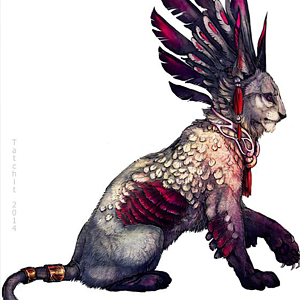
Information: The Featherpaw Necromancers are known for their extremely odd appearances. Many describe them as quite 'gothic', especially considering their status as domesticated felines in Ne'haer. However their appearance is merely to distinguish them from other cats - as a warning to predators who tend to actively avoid the Featherpaws. They are not called Necromancers for no reason, and possess a particularly odd ability that mages have researched for centuries to minimal avail. The way in which Featherpaw Necromancers defend themselves is merely by revealing their odd appearance, one that has been witnessed before by many predators lurking in the wilds of Ne'haer. A slain Featherpaw returns to life, and will hunt their attacker ruthlessly while enduring extreme wounds. It is also said that when a Featherpaw is consumed their flesh tastes rotten due to their reanimation, and so predators tend to avoid them as there is next to no point in risking death for a rotten meal.
Price: 120gn in Ne'haer, not found elsewhere; many people find them extremely unsettling and there is great superstition regarding the Featherpaws.
Habitat: Forests, plains, savannah and hills
Lifespan and Development: The Featherpaw cats live for about twenty years on average, a bit longer than other cats. They are generally about twice the size of the average domestic house cat, many comparing them almost to small-sized puma in appearance (if you disregard the feathers and whatnot). They mature at about a year and become venerable at around sixteen years of age, on average. Mostly their development is parallel to that of other domestic felines.
Diet: They are omnivores, though they prefer a carnivore habitat. Like dogs, they can consume starch products and other generally human foods without any setbacks, making them actually somewhat convenient when it comes to feeding.
Temperament: The Featherpaw tend to be even more independent and reserved than other cats, though they are actually less likely to get into fights or to attack someone unwarranted. This is an extreme variation from when they die, in which case their temperament is extremely violent and they attempt to pursue 'foes' until their absolute destruction.
Abilities: The Featherpaw Necromancer is called as it is due to a unique ability: self-reanimation. If one is to kill the Featherpaw, they will indeed die. Their life is evidently over. However, shortly after the death of a Featherpaw, they will raise from the dead and viciously pursue whichever individual was perceived to have killed them or resulted in their death. As they are considerably larger, faster and even more deadly than average cats, they are capable of doing extensive damage regularly and once they have been reanimated their strength and speed seem to multiply. While relatively harmless pets in life, in death the Featherpaw are dangerous predators who have actually been known to go toe-to-toe with Jaguars, who are some of the more prominent and capable felines.
Not more than a few breaks after their self-reanimation, however, they will die again and this time for good. It is due to this ability that many fear owning Featherpaws, as a mistake resulting in their injury - and inevitably death - can result in them coming back and murdering their master. Additionally, those who abused them or had a generally hostile relationship with them in life are often actually proactively hunted once they have come back. They are generally kept by wealthier owners who tend to spoil them for their exotic appearance. Not for the faint hearted or a family with children, to be sure.
Kejradin
Credit: Alistair
Found In: Ne'haer
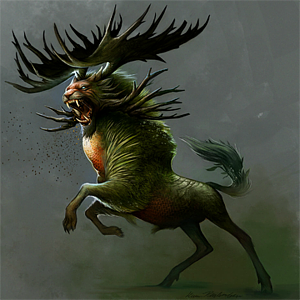
Information: The Kejradin, pronounced Kaer-ah-deen, is an apex predator and domesticated mount found within the unmarked lands west of Lysoria. Kaernhad represents the only place in the world to carry a significant population of Kejradin, known as the Kaern Wyvern to those far from the region.
The Kejradin is a domesticated beast known for its incredible sense of smell, mobility, and a unique biological trait that allows them to grow horns, splinters and spikes across its body, flinging these at foes with deadly precision. The creature can indeed fly, and is the chosen mount of the Aelothari Horde due to its general excellence and flexibility in combat. Physically, the Kejradin is considered an exceptionally powerful companion, with thick muscles, high agility and fair strength. Notably, the Kejradin are very familial, and tend to form incredibly large families, often treating their human companions and masters as members of their flock.
Price: 1,500 GN, 2,500 Trained
Lifespan and Development: The Kejradin wyvern are born via egg and kept high in the alpine mountains. After hatching, they require two to three years of life before reaching their maturing years and learning how to fly. After about four to five years of age, they are considered adults in their prime, and remain as such until their twenty fifth year. Remaining venerable from this point on, most Kejradin pass away at the age of thirty to thirty five.
Weight: They weigh, on average, about 1,800 lbs (or 816 kg). Male Kejradin tend to weigh about 10-20% more than female Kejradin, and usually sit at about 2,000 lbs (or 907 kg).
Diet: They are omnivores, though they prefer venison and lamb and are often domesticated by feeding them meats and proteins as developing pups.
Temperament: The Kejradin Wyvern are very protective of their family, and can be incredibly territorial. Unfortunately, most are domesticated by slaughtering their parents before them and their fellow pups (the term for their young) are taken in. Most Kejradin are mounts to the Aelothari Horde, a remaining Clan of Lotharro between Gauthrel and Lysoria.
Abilities: The Kejradin can grow spiked bones rapidly from many parts of their body, similar to the Albion of Gauthrel. They can launch these spikes at incredible precision, known to be capable of ripping through armor and puncturing flesh due to the high velocity and force of the flung shards. Additionally, the Kejradin can unfold (or rather expand) a set of wings from its arms at any time and take flight, making it an amiable mount for land and air. The Kejradin is a muscular, agile and durable creature, an incredible warmount far superior to both the Bruxen and Sohr Khal.